- Written by: ajworkteam60@gmail.com
- June 22, 2026
- Categories: Digital Agency, Digital Product
- Tags:
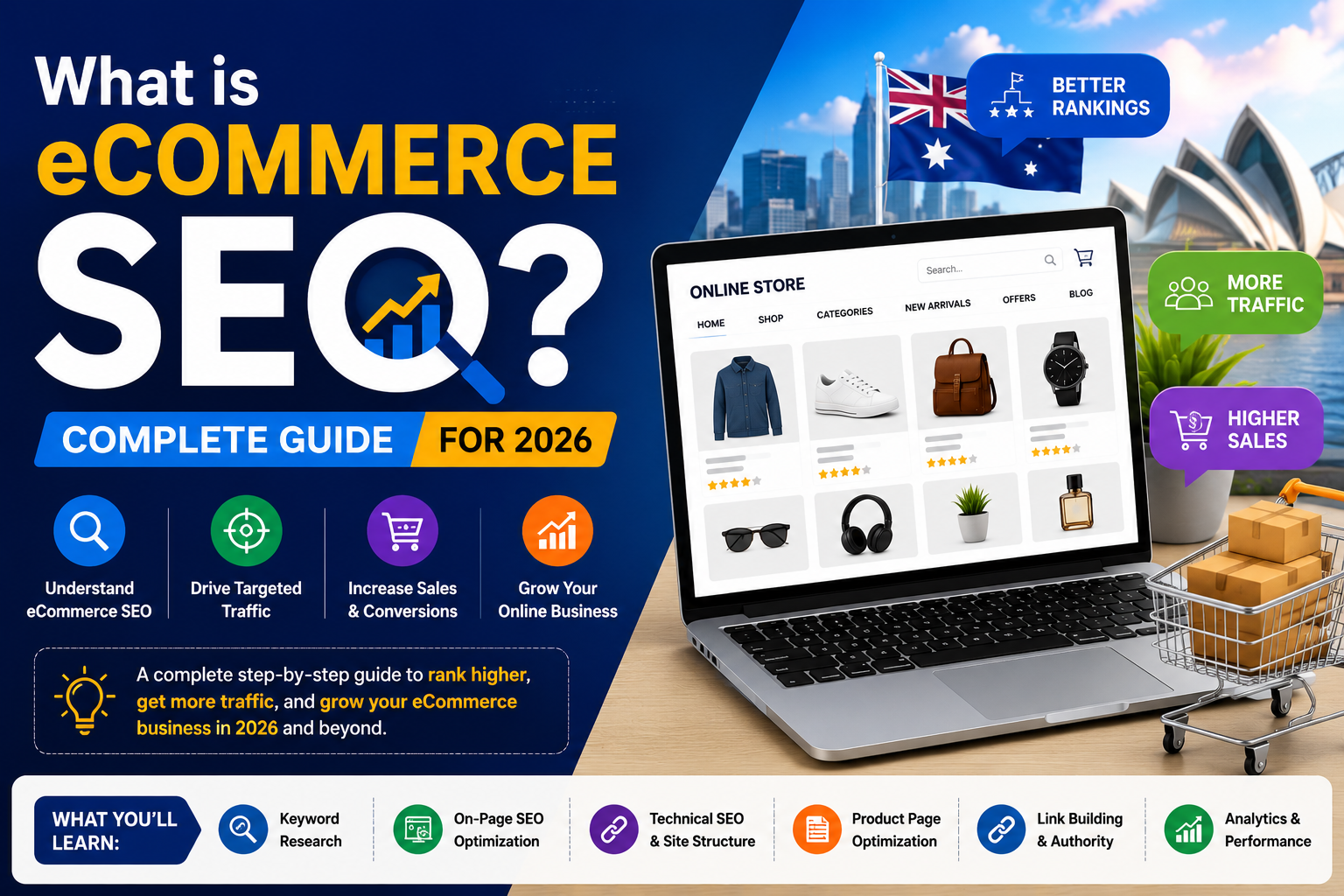
What is eCommerce SEO? (Complete Guide for 2026)
eCommerce SEO is the process of optimizing an online store so that it appears higher in search engine results when people search for products, categories, or buying-related queries.
The main objective of eCommerce SEO is not just to increase website traffic—but to attract high-intent buyers who are ready to purchase products online.
In 2026, eCommerce SEO has become more advanced than ever due to:
- Google algorithm updates focusing on user experience
- Rise of AI-powered search results (SGE, Gemini, ChatGPT browsing)
- Increased competition in online retail
- Higher advertising costs across Google Ads and Meta Ads
Because of these changes, SEO is no longer optional for online stores—it is a core growth system.
Whether you run a Shopify store, WooCommerce website, or a custom-built eCommerce platform, SEO determines how visible your business is in Google search results.
Understanding eCommerce SEO in Simple Terms
To understand eCommerce SEO, think of Google as a giant shopping marketplace.
Every time a user searches for a product like:
- “buy running shoes online Australia”
- “best laptop for students 2026”
- “affordable skincare products Australia”
Google decides which stores to show first based on:
- Relevance
- Authority
- Website structure
- Content quality
- User experience
eCommerce SEO helps your online store become the most relevant and trustworthy result.
Why eCommerce SEO is Important in 2026
The eCommerce industry has become extremely competitive. Thousands of new online stores are launched every day across platforms like Shopify, WooCommerce, Amazon, and independent websites.
Without SEO, most online stores depend heavily on paid advertising.
However, paid ads have limitations:
- Traffic stops when budget ends
- Cost per click keeps increasing
- Competition increases daily
- Lower long-term ROI
SEO solves this problem by building long-term organic visibility.
With SEO, your store can:
- Rank on Google without paying for every click
- Generate consistent organic traffic
- Build brand trust and authority
- Reduce dependency on ads
- Increase long-term revenue stability
For Australian businesses specifically, SEO is even more important because:
- Google Australia search competition is rising
- Local buyers trust organic results more than ads
- Shipping-based businesses rely heavily on search visibility
- CPC costs in Australia are among the highest in retail niches
How eCommerce SEO Works (Step-by-Step Explanation)
eCommerce SEO works by optimizing multiple layers of your website so search engines can understand, index, and rank your pages effectively.
It is not a single action—it is a system.
Step 1: Keyword Research (Understanding Customer Intent)
Keyword research identifies what your customers are searching for.
Instead of guessing, SEO uses data-driven search intent categories:
🔵 Transactional Keywords (Buy Intent)
- buy wireless headphones Australia
- best running shoes for men 2026
- order skincare products online
🟡 Commercial Keywords (Comparison Stage)
- best headphones under $200
- top skincare brands Australia
- Nike vs Adidas running shoes
🟢 Informational Keywords (Research Stage)
- how to choose running shoes
- benefits of skincare routine
- what is noise cancelling headphones
Each keyword type plays a role in the customer journey.
Step 2: Site Structure Optimization
A well-structured website helps Google understand your content hierarchy.
Ideal structure:
Home
→ Category Pages
→ Subcategories
→ Product Pages
Example:
Home
→ Men’s Shoes
→ Running Shoes
→ Nike Air Zoom Pegasus
This structure:
- Improves crawl efficiency
- Strengthens topical authority
- Enhances user navigation
- Distributes SEO value across pages
Step 3: Product Page Optimization
Product pages are the most important revenue-driving pages.
Each product page should include:
✔ SEO-Friendly Titles
Example:
Nike Air Zoom Pegasus Running Shoes for Men Australia
✔ Unique Product Descriptions
Avoid manufacturer descriptions. Instead:
- Focus on benefits
- Include use cases
- Add semantic keywords
✔ Image Optimization
- Compress images
- Add alt text
- Use descriptive file names
✔ Schema Markup
Structured data helps Google show:
- Price
- Ratings
- Availability
- Reviews
Step 4: Category Page Optimization
Category pages are often more powerful than product pages.
They target broader keywords such as:
- “Men’s running shoes Australia”
- “Best smartphones online”
A strong category page includes:
- 500–1000 words of SEO content
- Internal links to products
- Keyword clusters
- FAQ section
Step 5: Technical SEO Optimization
Technical SEO ensures your website is healthy and fast.
Key improvements include:
Website Speed
- Reduce load time under 2.5 seconds
- Compress images
- Use caching systems
Mobile Optimization
- Responsive design
- Mobile-first UX
Indexing Control
- Fix duplicate pages
- Use canonical tags
- Remove thin pages
Core Web Vitals
Google evaluates:
- LCP (Loading performance)
- INP (Interaction speed)
- CLS (Visual stability)
Step 6: Content Marketing Strategy
Content marketing builds authority and supports product rankings.
Types of content include:
- Buying guides
- Product comparisons
- Educational blogs
- Industry insights
Example topics:
- Best Running Shoes in Australia 2026
- Shopify vs WooCommerce SEO Guide
- How to Choose the Right Laptop
This helps attract users at early stages of the buying journey.
Step 7: Authority Building (Backlinks)
Backlinks are one of the strongest Google ranking signals.
They show that your website is trusted by others.
Common strategies:
- Guest posting
- Digital PR
- Influencer mentions
- Industry directories
- Niche blog outreach
High-quality backlinks improve:
- Domain authority
- Keyword rankings
- Trust signals
Step 8: Conversion Optimization
SEO is not just about traffic—it’s about sales.
Conversion optimization ensures visitors become customers.
Key elements:
- Clear product pages
- Strong call-to-action buttons
- Trust badges
- Customer reviews
- Easy checkout process
Even small improvements in conversion rates can significantly increase revenue.
eCommerce SEO vs Traditional SEO
| Feature | eCommerce SEO | Traditional SEO |
| Focus | Products & sales | Information content |
| Pages | Product & category pages | Blog articles |
| Goal | Revenue growth | Traffic generation |
| Intent | Buyer intent | Informational intent |
GEO SEO (Australia-Focused Optimization)
For Australian online stores, GEO SEO is critical.
This includes using location-based keywords such as:
- Online store Australia
- Buy products Sydney
- Melbourne electronics store
- Brisbane fashion shop
It also includes:
- Australian pricing signals
- Local shipping information
- Region-specific keywords
This improves visibility in local Google Australia search results.
E-E-A-T in eCommerce SEO
Google evaluates websites based on:
Experience
Real-world product knowledge and usage expertise.
Expertise
High-quality, detailed SEO content and product understanding.
Authoritativeness
Backlinks, brand mentions, and industry presence.
Trustworthiness
Secure website, transparent business details, and customer trust signals.
Benefits of eCommerce SEO
A strong SEO strategy provides:
- Long-term organic traffic
- Lower customer acquisition costs
- Higher conversion rates
- Brand authority growth
- Sustainable business growth
How Long Does eCommerce SEO Take?
SEO is a long-term investment.
Typical timeline:
- 1–2 months: Technical fixes
- 3–4 months: Keyword rankings begin improving
- 5–6 months: Traffic growth becomes visible
- 6–12 months: Strong ROI and conversions
Is eCommerce SEO Worth It?
Yes—because it builds a compounding growth system.
Unlike paid ads:
- SEO traffic is free per click
- Rankings improve over time
- ROI increases continuously
FAQs (AEO Optimized)
❓ What is eCommerce SEO?
eCommerce SEO is the process of optimizing online stores to rank higher in search engines and attract buyers ready to purchase products.
❓ How does eCommerce SEO work?
It works by optimizing product pages, category pages, technical SEO, and content to improve search visibility.
❓ Why is eCommerce SEO important?
It helps online stores generate consistent traffic and sales without relying on paid advertising.
❓ What are the main parts of eCommerce SEO?
Keyword research, on-page SEO, technical SEO, content marketing, and backlinks.
❓ How long does SEO take?
Most stores see results in 3–6 months depending on competition and website quality.
❓ Is SEO better than ads?
SEO provides long-term growth, while ads provide short-term traffic. Both work best together.
❓ Can SEO increase sales?
Yes. SEO attracts high-intent users who are actively searching for products.
🧠 Final Summary
eCommerce SEO is a complete system that combines keyword research, site structure, content marketing, technical optimization, and authority building to help online stores rank higher and generate consistent sales.
In 2026, businesses that invest in SEO will outperform those relying only on paid advertising.
For Australian online stores, implementing a structured SEO strategy is one of the most effective ways to build long-term digital growth and revenue.